
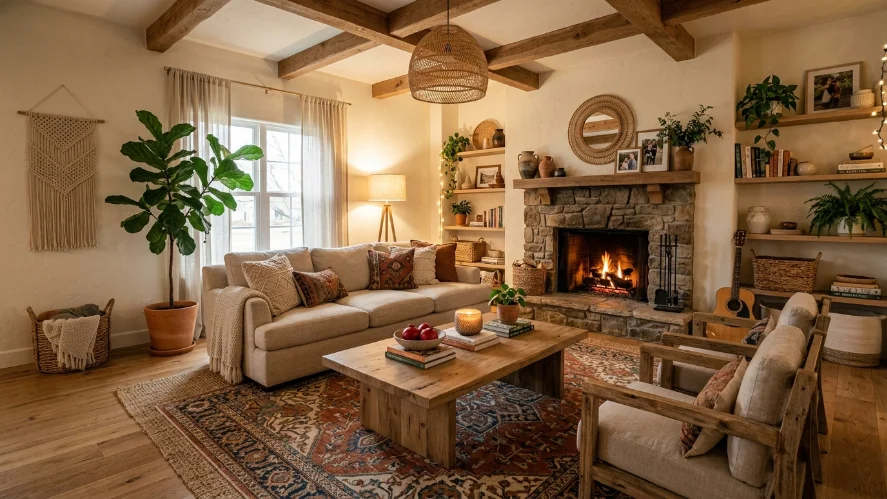
For the longest time, I convinced myself that bohemian decor wasn’t for me. My house is a late-90s suburban build outside Charlotte not exactly the sun-drenched, open-beamed loft you picture when someone says “boho.” I had builder-grade oak trim, an open floor plan that swallowed small accents whole, and a five-year-old who treats throw pillows like dodgeballs. Bohemian home decor, I assumed, was for people who had their aesthetic figured out people who’d traveled, collected things, and knew how to layer a kilim rug without it looking like a yard sale.
What shifted things was a HomeGoods run in early 2023 where I grabbed a woven rattan mirror on impulse $34, about 18 inches across because I liked the shape. I hung it in our hallway without a plan. My husband Mark walked past it and said, “That actually looks really good.” High praise from a man who has never once mentioned a piece of decor unprompted. Something clicked: bohemian style isn’t about having all the pieces at once. It’s about layering things you actually like until the room starts to feel like yours.
Two-plus years later, our living room and bedroom both have strong boho-leaning character. I’ve made a lot of mistakes along the way. But I’ve also figured out what actually works in a real house with two kids, a shedding dog, and North Carolina humidity trying to warp everything I own.
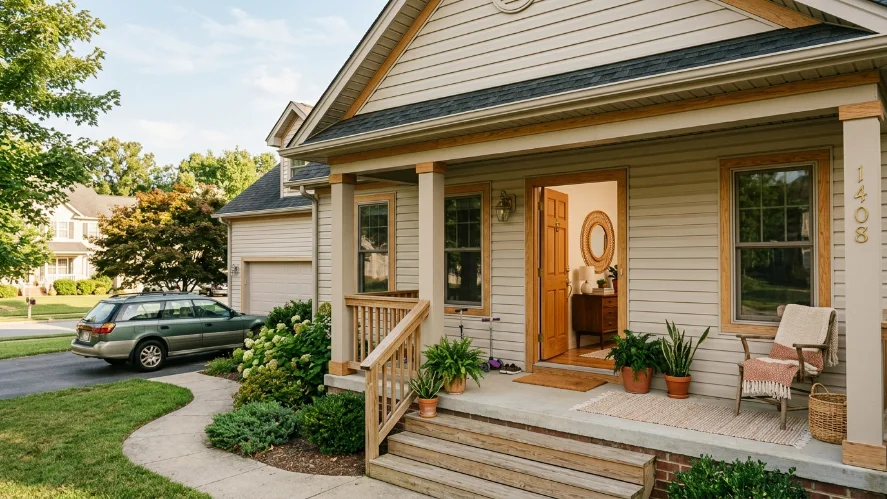
The Part Where I Got It Completely Wrong First
My first real attempt at bohemian home decor was a disaster, and I think it’s important to say that out loud.
I’d seen a Pinterest board with a white linen sofa, a Turkish rug, candles in three different sizes, a macramé wall hanging, a jute pouf, floor plants, and what appeared to be seventeen throw pillows. I thought: I’ll just buy all of that. Logical, right?
The problem was that none of it was mine. The linen sofa was beautiful for approximately six days before Biscuit (our dog) made himself at home. The macramé I ordered from Wayfair arrived damaged, and I missed the return window because life. The Turkish rug I found on Amazon for $89 looked fine in the listing photos but felt like cheap plastic underfoot nothing like the warm, worn-in texture I’d imagined.
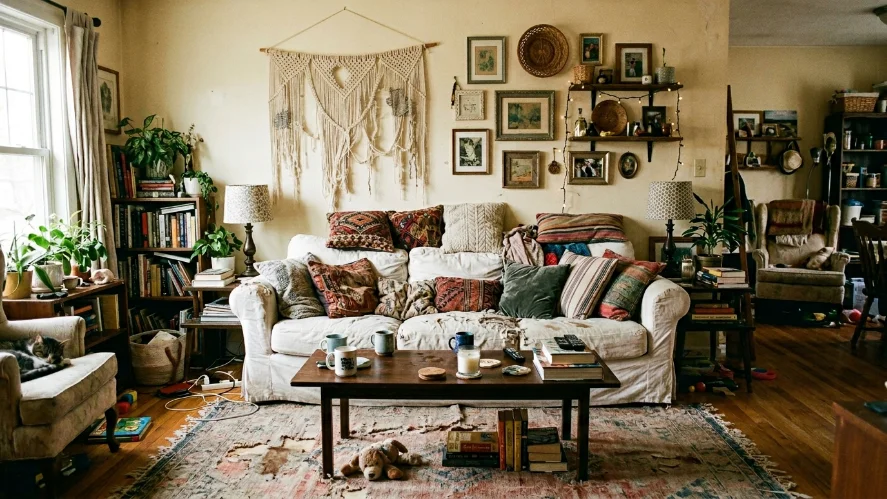
I returned what I could, shoved the rest into the closet, and sat on my bare living room floor feeling genuinely defeated.
What I eventually understood through a lot of trial and error is that bohemian style is not a shopping list. It’s a process. The rooms that look effortlessly layered and personal? They got that way because someone spent time filling them slowly, with things they actually chose instead of things they thought they should have.
Start With One Anchor Piece, Not a Full Room Refresh
Every boho room I’ve loved has one piece doing the heavy lifting. It might be a large vintage rug, a dramatic wall hanging, or an interesting piece of furniture that clearly has a story. Everything else in the room feels like it’s orbiting that one thing.
In our living room, that anchor became a vintage-style Moroccan-pattern area rug I found on Ruggable for around $220 one of the more considered splurges I’ve made, and worth every dollar because it’s machine-washable (non-negotiable with kids). The rug has deep rust, navy, and cream tones that ended up pulling the whole color story for the room. I didn’t plan that. It just happened because I gave the rug enough visual weight to lead.
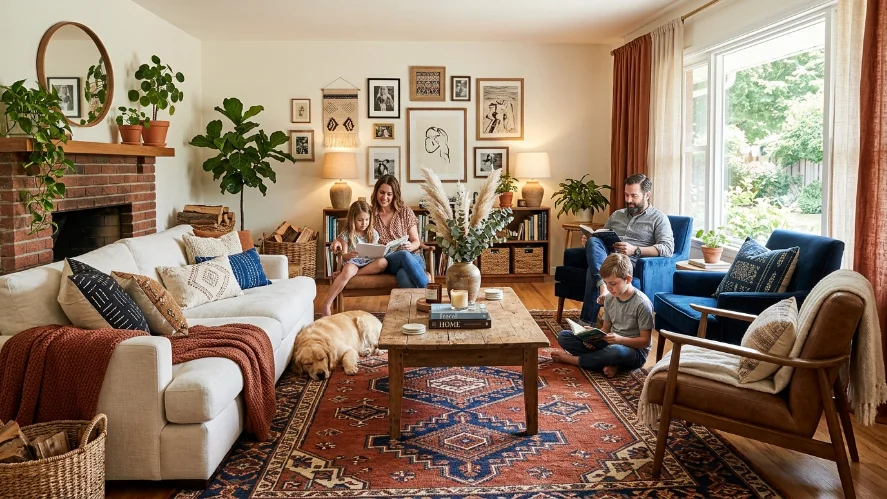
If that’s out of budget, Facebook Marketplace is genuinely good for rugs. I’ve seen actual vintage kilims go for $40–80 in our area because people don’t always know what they have. You’ll need to spot-test for cleanliness and check the pile, but a real vintage rug at $60 will outperform a cheap machine-made one at twice the price.
Let the Anchor Tell You What to Add Next
Once the rug was down, I stopped trying to plan the room from scratch. Instead, I just asked: what does this rug want next to it? The rust tones called for warm lighting. The navy suggested I didn’t need anything cool-toned on the walls. The cream made me want natural textures woven, linen, unfinished wood.
That one question what does this want next to it? made every future buying decision easier.
Texture Over Pattern: The Easiest Way to Build a Boho Feel
Bohemian style is famous for pattern mixing, and yes, that’s part of it. But texture is what makes a room feel full and layered even when you’re not ready to mix four different prints on a sofa.
In our bedroom, I started with a natural linen duvet from Quince (around $90 on sale) and added a chunky-knit cotton throw from Target $38, cream-colored, slightly imperfect weave. Then came a woven basket from HomeGoods ($22) that holds Biscuit’s spare toys because every surface in our house eventually becomes dog-adjacent. None of those things are patterned. But together, they make the room feel layered and intentional.
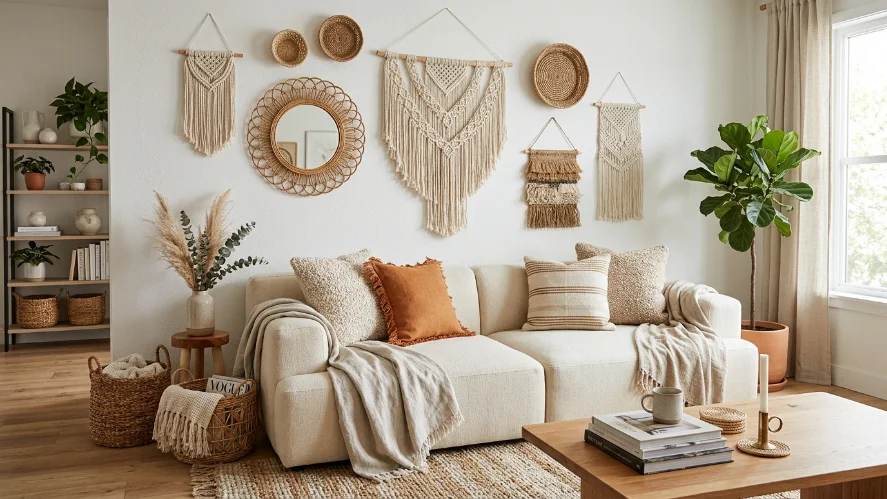
Texture sources I actually use:
- Macramé wall hangings (smaller ones, $25–45 from Etsy shops, hold up better than mass-produced)
- Rattan and bamboo frames for gallery walls
- Linen and cotton slipcovers (Target’s linen-blend options have gotten genuinely good)
- Jute and seagrass baskets in different sizes
- Woven or boucle accent pillows
The Charlotte humidity is worth mentioning here: natural fibers like jute and seagrass can soften and loosen in humid Southern summers. I keep a dehumidifier running through June–August, which helps. If you’re in a similarly humid climate, check seams and woven pieces after the first summer season.
Color in Bohemian Decor: Why “Earthy” Doesn’t Mean Boring
I used to think bohemian color palettes meant brown and beige and beige and brown. Some rooms do lean that way and honestly, that can look incredible when it’s done intentionally. But the boho palette is wider than that.
Our living room now has warm white walls (Sherwin-Williams Alabaster, which has worked well in our north-facing rooms where it doesn’t go pink or yellow), the rust-and-navy rug as the foundation, and then accents in terracotta, aged brass, and deep olive green. It sounds like a lot. It doesn’t read as a lot in person because all the colors are warm-toned and muted.
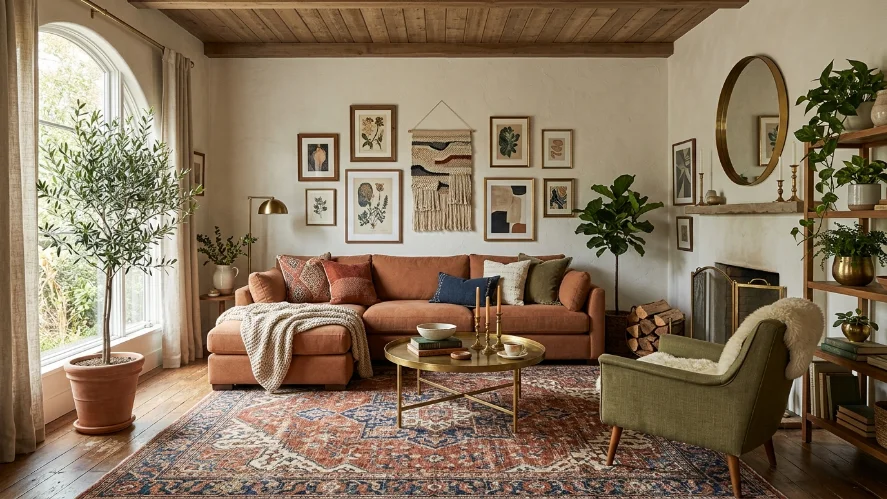
The mistake I made in year one was mixing cool-toned blues and greens with warm rust and wood it kept the room from cohering. Once I pulled anything with gray undertones out of the space, things clicked into place.
Budget alternative: you don’t need to repaint for a color shift. Start with two or three throw pillows in a cohesive palette. If the room still feels off after that, then revisit walls.
The Plants Situation Real Talk
Every bohemian home decor inspiration image has plants. Lots of plants. I am here to tell you that I have killed many plants, and I have made peace with that.
What works in our house: pothos (genuinely unkillable), a ZZ plant in the bedroom corner, and a fiddle-leaf fig that I’ve managed to keep alive for 18 months by ignoring conventional advice and just watering it when the soil is completely dry. What did not work: any succulent I’ve ever owned, because the NC summer humidity makes them rot, and anything that needs direct southern light when I have north-facing windows.
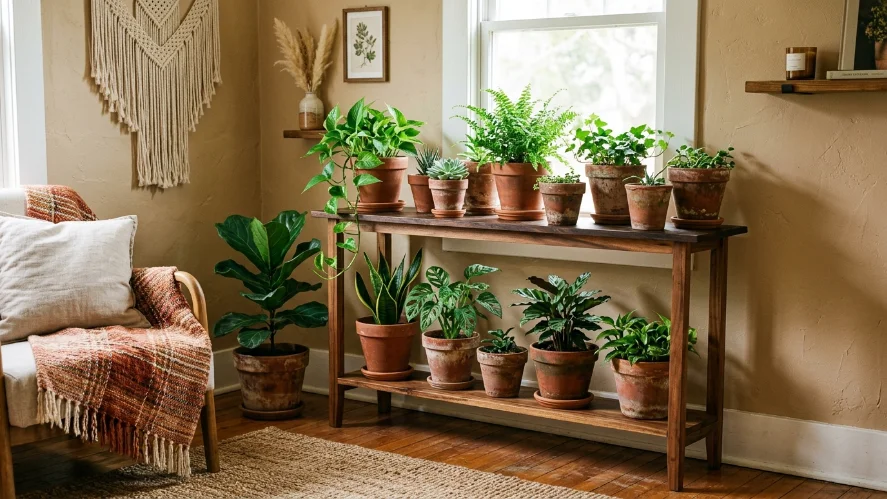
Fake plants are fine. I said what I said. We have two realistic-looking faux eucalyptus stems in a terracotta pot in the corner of the living room, and no one has ever asked whether they’re real. The textural quality of a quality fake plant around $18–35 from Target or World Market contributes to the layered look just as well as the real thing.
Ceramic and terracotta pots matter more than people think. Even a bare pot, in the right shape and color, adds to a boho vibe. I picked up four mismatched terracotta pots from our local Goodwill for a total of $7 and grouped them on a plant stand from IKEA ($29). Grouped, they look like a considered collection. Separated, they’d look like random yard stuff.
The Small DIY That Actually Changed the Room
Six months into decorating our living room, the walls above the sofa felt wrong. Too blank. I’d been nervous about creating a gallery wall because I’d seen too many versions that looked chaotic and amateur random frames, mismatched sizes, no logic to the arrangement.
What I did instead: I bought five identical 5×7 rattan-frame mirrors from Michaels ($9 each on a sale week) and arranged them in a loose cluster above the sofa. The mirror arrangement took three tries to get right. First attempt, I used painter’s tape to map it out on the wall, which is the correct advice everyone gives and I still managed to hang two frames where the tape marks suggested but the visual balance was off. Second attempt was better. Third attempt, I moved one frame about four inches to the right and it finally looked intentional.
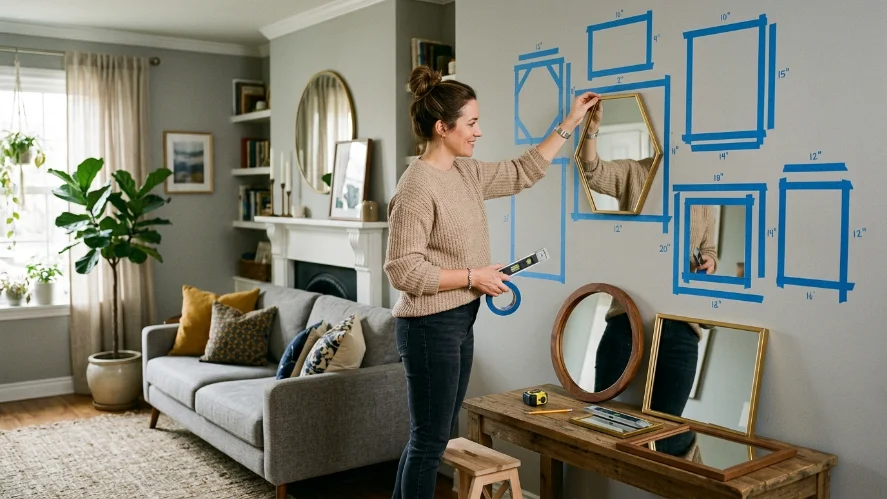
The whole project cost $45 in frames and about $8 in picture hooks. It looks like something from a design magazine or at least that’s what my neighbor said when she came over.
Where it went slightly wrong: I was too careful hanging them in a grid-ish pattern at first. Boho groupings need a little asymmetry. Once I let go of trying to make it mathematically even, the arrangement got better.
CTA:
Ready to bring bohemian style into your own home without the overwhelm? Start with one meaningful piece, layer in cozy textures, and give yourself permission to build your space slowly over time. Boho decor isn’t about perfection it’s about creating a warm, personal home that reflects your life, your family, and the things you genuinely love. Whether you’re adding a vintage rug, woven accents, earthy colors, or a few practical plants, every thoughtful choice helps shape a space that feels collected and inviting. Your dream boho home doesn’t happen overnight, but with intentional styling and real-life practicality, you can create a beautiful, lived-in space that feels uniquely yours.
If you’re in the middle of creating your own cozy boho-inspired space, I’d love to hear what pieces have made the biggest difference in your home. Share your favorite boho decor finds in the comments, save this post for future inspiration, and explore more home styling ideas to keep building a space that feels beautifully personal.
What I’d Do Differently If I Started Over
I’d go slower. That sounds obvious, but I mean it practically: I’d set a rule that I could only add one new piece to a room per month. Waiting forces you to live with what you have and figure out what’s actually missing, rather than filling every surface and then rearranging forever because nothing feels right.
I’d also skip mass-produced macramé entirely. The ones that arrive from large online retailers are fine, but the handmade ones from small Etsy shops usually $35–75 for a medium wall piece have character that you can actually see up close. The variations in the knots, the slight imperfections, the unique fringe lengths. That’s what makes something feel collected rather than purchased.
The other thing I’d skip: matching sets. Bohemian style resists the urge to buy the couch-and-loveseat combo, the matching nightstand pair, the identical lamp set. Mix your wood tones. Buy mismatched nightstands. Get a lamp from one place and a shade from another. The mismatch, when it’s intentional and color-cohesive, is what makes the room feel like it evolved rather than arrived from a showroom.
